


Beginner’s Guide for Sailors and Fishermen
For the uninitiated, the dashboard of a modern sailing yacht or small fishing boat can look incredibly complicated. Let’s continue learning the basics of boat electronics together.

A dizzying array of screens, buttons, and knobs might seem overwhelming, but fear not! Marine electronic devices, while sophisticated, are designed to make your time on the water safer, more efficient, and more enjoyable. This guide will introduce absolute beginners to the fundamental electronic systems you’ll encounter, explaining what they are and why they’re essential.
The Core Trio: Navigation, Communication, and Safety
At their heart, most marine electronic systems fall into one of three critical categories: navigation, communication, and safety. Understanding these broad classifications will help you grasp the purpose of individual devices.
Mastering the basics of boat electronics will give you confidence in using advanced marine equipment.
Navigating Your Way: Knowing Where You Are and Where You’re Going
Gone are the days when a paper chart and a compass were your only navigational tools (though they remain vital backups!). Modern electronics provide real-time, precise information to keep you on course.
When you grasp the basics of boat electronics, you’ll find navigating becomes second nature.
GNSS (Global Navigation Satellite System): Often just called GPS (Global Positioning System) after the original system owned by the USA, there are now several systems in operation: GPS (USA), GLONASS (Russia), BeiDou (China), and Galileo (EU). Most modern receivers can decode more than one or even all of them. This is the bedrock of modern marine navigation. A GNSS receiver pinpoints your exact location on the Earth’s surface using signals from satellites. On a boat, this information is often displayed on a Chartplotter.
- Learning the basics of boat electronics ensures you can maximise the functionality of your equipment.
- The basics of boat electronics include understanding how different systems work together.
How does satellite positioning work?

GNSS positioning systems consist of a constellation of satellites that transmit their identification and a time signal. A tracking almanack is also transmitted. The receiver calculates the position of each satellite using the information contained in the almanack and the current time. With that information, and since these signals travel at the speed of light, your receiver can calculate how far away each satellite is by measuring how long the signal took to arrive. Three satellites are required for a 2D fix, and at least four are needed for a 3D fix.
Chartplotter: Think of this as a digital map display. It shows your boat’s position overlaid on electronic charts, which are essentially digital versions of traditional paper charts, although there are important differences. This image shows the Garmin Echomap Ultra 2.

Chartplotters can display a wealth of information, including depth contours, navigation buoys, landmasses, and even real-time weather overlays. Many modern chartplotters are multi-function displays (MFDs) that can integrate with other systems.
Depth Sounder/Fishfinder: Essential for both safety and fishing. A depth sounder uses sonar to measure the depth of the water beneath your hull, helping you avoid running aground. A fishfinder is a more advanced version that displays echoes from fish and underwater structures, making it invaluable for anglers.
Another type of sonar, sidescan, allows you to see out to the side of your boat and provides an almost photographic representation of the seabed and objects on it.
How does a depth sounder work?
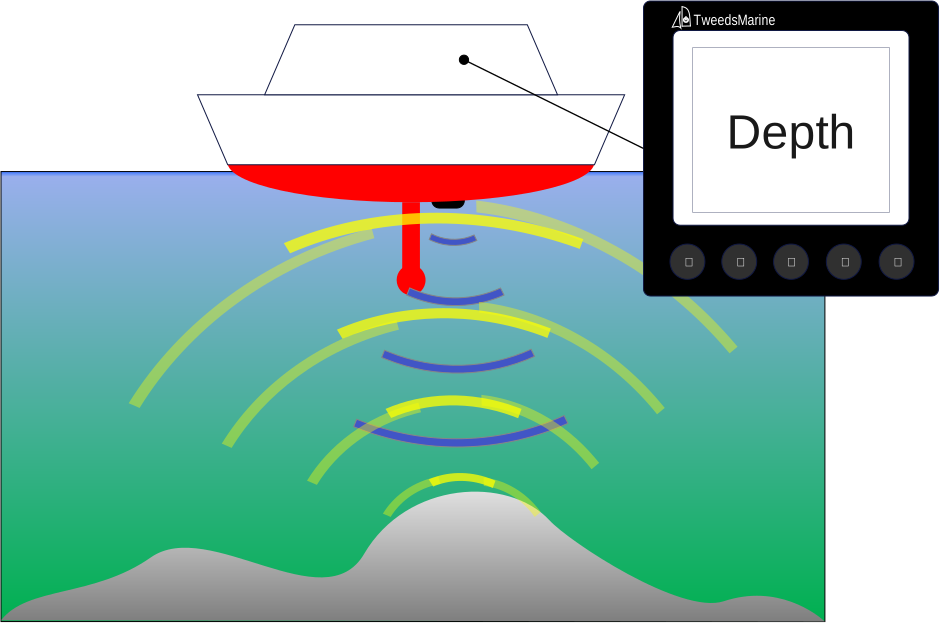
A depth sounder transmits an acoustic signal (usually between 50 and 200kHz) in pulses from a transducer mounted on the hull of the boat. These pulses are reflected off the seabed or fish and received by the same transducer. The depth is calculated from the time it takes for the signals to return and is displayed on the vessel’s instruments.
Autopilot: This incredible convenience allows the boat to steer itself on a set course, freeing you up to attend to other tasks or enjoy the ride. Autopilots work by integrating with your GPS and compass.
WARNING! An autopilot should never be left unattended!
Radar: For more serious cruisers and offshore fishing, radar is a game-changer, especially in low visibility conditions like fog or darkness. Radar sends out radio waves and detects their reflections (echoes) from other boats, land, buoys, flocks of birds, debris, and even weather systems, displaying them on a screen. This significantly enhances collision avoidance.
This RADAR screen shows an image of a marina. The screen is set to simultaneously show two ranges: 1/8 of a NM on the left and 1/2 of a NM on the right. You can see the rows of pontoons and even make out individual boats moored to them.

Staying Connected: Communication on the Water
While enjoying the solitude of the open water, it’s crucial to have reliable ways to communicate, both for routine calls and emergencies.
VHF Radio (Very High Frequency): This is the primary means of short-range communication on the water. Every boat should have one or more VHF radios. VHF radios allow you to:
- Communicate with other vessels (boat-to-boat).
- Contact shore stations (marinas, lock keepers, bridge tenders, coastguard, harbour control, etc.).
- Receive weather alerts.
- Most importantly, make distress calls (Channel 16 is the international hailing and distress channel). Many modern VHF radios feature DSC (Digital Selective Calling), which allows you to send a digital distress alert with your boat’s identity and position to the Coastguard and other DSC-equipped vessels.
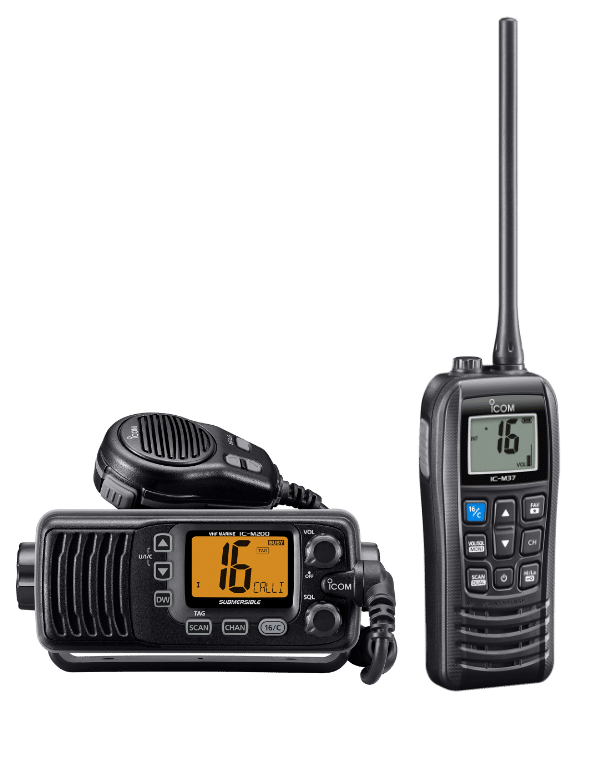
VHF radios come in two main formats: fixed installations and hand-held portable sets. If possible, have at least one of each aboard, as this allows crew aboard to communicate with crew who may be away from the mothership, in the tender, for example. The radios pictured are from ICOM
- As you learn the basics of boat electronics, you’ll become more adept at troubleshooting issues.

EPIRB (Emergency Position Indicating Radio Beacon) & PLB (Personal Locator Beacon): These are vital safety devices. In a life-threatening emergency, activating an EPIRB (for the vessel) or PLB (personal use) transmits a distress signal via satellite to rescue authorities, providing your exact location. They are a last resort, but can be lifesavers. The image shows a PLB and an EPIRB from GME
AIS SART (Search and Rescue Transponder): See below for more information on what AIS is. These devices attach to a lifejacket or liferaft and transmit your location in the case of an MOB (Man Over Board) or abandoning ship.
AIS SARTS have an advantage over EPIRBs and PLBs because any vessel within range will be immediately alerted to the emergency. In the case of an MOB, the crew aboard the vessel can use the AIS signal to return the MOB’s location.
Satellite Communicators/Phones: For offshore adventures beyond VHF range, satellite phones or dedicated satellite communicators allow you to make calls, send texts, and access limited internet services.

Enhancing Safety and Awareness: Beyond the Basics
Communication devices are a key aspect of the basics of boat electronics for safety.
- Every boater should understand the basics of boat electronics, including VHF radio operation.
Several other electronic systems contribute significantly to your safety and situational awareness.
AIS (Automatic Identification System): AIS is becoming increasingly common and is a fantastic safety tool, especially in busy shipping lanes. It automatically transmits your boat’s position, course, speed, and other data to other AIS-equipped vessels and shore stations. Crucially, it also receives the same information from them, displaying it on your chartplotter. This allows you to “see” and be “seen” by other vessels, even if they are out of sight, helping you avoid collisions.

VHF radios are a critical part of the basics of boat electronics for both recreational and emergency use.
AIS operates on the same VHF marine radio frequencies as your radios and often shares the same antenna. AIS signals can also be received by satellites and relayed to ground stations, meaning that your location can be tracked almost globally.
In addition to vessels, many ports now transmit virtual ATONs (Aid TO Navigation) such as buoy positions or special navigation areas.
There are receive-only AIS units that can be much cheaper than transceivers (transmit & receive) but still allow you to monitor vessel traffic around you.
Bilge Pumps & Alarms: While not strictly “electronics” in the navigational sense, electrically operated bilge pumps are essential for removing water from your hull, and electronic alarms can alert you to high water levels.
Bilge alarms can often be integrated in vessel monitoring systems that can send alerts to absent owners via WiFi or text messages.
Battery Monitors: Knowing the state of your boat’s batteries is crucial. Electronic battery monitors provide real-time information on voltage, current draw, and remaining capacity, helping you manage your power consumption and avoid being stranded with flat batteries. This information can also be displayed on your chartplotter or MFD (see this article Transform Your Boating with Analogue Sensors on a NMEA 2000 Network for more information).
Powering Your Electronics: All these fantastic devices rely on your boat’s electrical system, typically 12-volt DC (direct current). Understanding the basics of battery management, charging systems (alternators on your engine, solar panels, wind generators), isolator switches, fuses, and circuit breakers is essential for reliable and safe operation. See this article, Boosting Marine Network Reliability: 3 Essential Areas to Improve for more.
Battery management is part of mastering the basics of boat electronics for powering devices.
Getting Started: What Do You Really Need?
For absolute beginners on a small sailing yacht or fishing boat, here’s a suggested basic boat electronics starting point:
- VHF Radio (with DSC): Non-negotiable for communication and safety.
- GPS/Chartplotter: Essential for knowing your position and navigating safely.
- Depth Sounder: Crucial for avoiding shallow water (this could be, and often is, integrated into the chartplotter).
- Basic Battery Monitor: To keep an eye on your power supply.
As you gain experience and venture further afield, consider adding an Autopilot, AIS, EPRIB, PLB or AIS SART, and eventually Radar.
Learning and Practice
- Understanding the basics of boat electronics can enhance your boating experience significantly.
Marine electronics, while powerful, require a bit of learning. Ask somebody knowledgeable to demonstrate the various gadgets, read your manuals, watch online tutorials, and most importantly, practice using your equipment in calm conditions before relying on it in challenging situations.
There is more to effectively and legally using a radio than knowing what the various buttons do. I strongly urge you to take a VHF operators course. In New Zealand, these are run by the Coastguard Maritime VHF Certificate Course, online via eNautical, or at various sailing clubs and colleges that run a maritime syllabus. In the UK, the RYA offers the courses.
Familiarity breeds confidence and ensures you can leverage these incredible tools to their full potential, making your time on the water safer and more enjoyable. Welcome to the world of marine electronics – a world that opens up new horizons for your boating adventures!
Summary
The basic boat electronics devices aboard fall into one of three main categories:
- Navigation
- Communications
- Safety
As a bare minimum, never leave port without at least two forms of communication and a method of navigation that you are familiar with and confident to use.
Safe boating relies on you knowing how these systems are operated and, preferably, a little bit about how they work, which will give you some ability to troubleshoot when something goes wrong.
For more in-depth information on how all of these systems can tie together, please check out my series of articles, Introduction to marine electronics networking
Frequently Asked Questions (FAQ) — Demystifying Marine Electronics
What are the core categories of marine electronics?
Marine electronics generally fall into three main categories: navigation, communication, and safety. Navigation devices help you know your position and course, communication devices keep you connected with other vessels and shore stations, and safety electronics assist in emergencies and situational awareness.
What is GNSS and how does it help with marine navigation?
GNSS (Global Navigation Satellite System) refers to satellite constellations like GPS (USA), GLONASS (Russia), BeiDou (China), and Galileo (EU) that provide precise positioning data. Marine GNSS receivers use signals from these satellites to pinpoint your boat’s exact location, which is displayed on chartplotters for safe and accurate navigation.
How does a chartplotter work?
A chartplotter is a digital map display that overlays your boat’s position on electronic nautical charts. It shows depth contours, navigation aids, landmasses, and can integrate weather and AIS data. Many modern chartplotters are multifunction displays (MFDs) that combine navigation, radar, and other systems into one interface.
What is the difference between a depth sounder and a fishfinder?
A depth sounder uses sonar pulses to measure water depth beneath your boat, helping avoid shallow areas. A fishfinder is a more advanced sonar device that also detects fish and underwater structures, displaying them graphically to assist anglers.
How does an autopilot work on a boat?
An autopilot automatically steers your boat on a set course by integrating with your GPS and compass. It frees you from manual steering but should never be left unattended, as conditions can change rapidly.
Why is radar important for marine safety?
Radar sends out radio waves and detects their echoes from other vessels, land, buoys, and weather systems. It is invaluable in low visibility conditions like fog or darkness, enhancing collision avoidance and situational awareness.
What communication devices are essential on a boat?
The primary communication device is the marine VHF radio, used for short-range voice communication with other boats and shore stations. Many VHF radios include Digital Selective Calling (DSC) for automated distress alerts. For offshore or beyond-VHF-range communication, satellite phones or communicators provide voice and data connectivity.
What are EPIRBs, PLBs, and AIS SARTs?
EPIRB (Emergency Position Indicating Radio Beacon): A device that transmits a distress signal via satellite to rescue authorities in emergencies.
PLB (Personal Locator Beacon): A portable distress beacon for personal use.
AIS SART (Search and Rescue Transponder): Transmits your location to nearby vessels equipped with AIS, especially useful for man overboard situations.
How does AIS improve boating safety?
AIS (Automatic Identification System) automatically broadcasts your vessel’s position, course, and speed to other AIS-equipped boats and shore stations, and receives the same data from them. This “see and be seen” capability helps avoid collisions, especially in busy waterways or poor visibility.
What role do bilge pumps and alarms play in marine electronics?
Bilge pumps remove unwanted water from your boat’s hull, while electronic bilge alarms alert you to high water levels. Integrated bilge monitoring systems can send alerts remotely, helping prevent flooding and damage.
Why is battery monitoring important on boats?
Battery monitors provide real-time data on voltage, current, and remaining capacity, helping you manage power consumption and avoid unexpected power loss. This is critical for ensuring all your marine electronics remain operational.
What basic marine electronics should beginners have on their boat?
For beginners, essential electronics include:
VHF Radio with DSC for communication and safety.
GPS/Chartplotter for navigation.
Depth Sounder to avoid shallow waters.
Basic Battery Monitor to track power supply.
As experience grows, consider adding autopilot, AIS, EPIRB/PLB, AIS SART, and radar.
How can I learn to use marine electronics effectively?
Practice using your equipment in calm conditions, read manuals, watch tutorials, and seek demonstrations from experienced users. Taking recognized courses, such as VHF operator certifications, greatly improves your confidence and safety.
How do marine electronics integrate with a boat’s electrical system?
Most marine electronics run on 12V DC power from the boat’s battery system. Proper wiring, fuses, circuit breakers, and battery management systems are essential for reliable and safe operation.
Where can I find more information about marine electronics networking?
For a deeper understanding of how marine electronics systems connect and communicate, check out the article series on Introduction to marine electronics networking.


One comment
[…] The Basics of Boat Electronics […]