
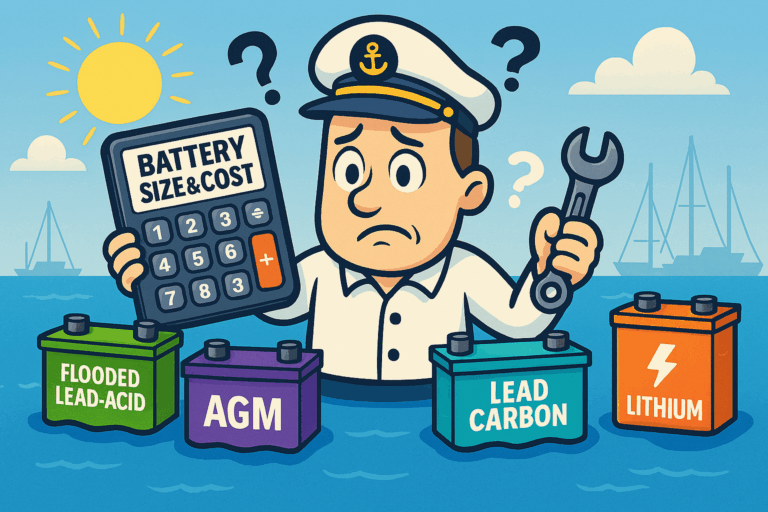
Welcome to the TweedsMarine Battery Calculator! You will find it below this guide or directly on its own page Battery Calculator. This tool helps you estimate the size, battery chemistry and cost of the battery bank you need for your boat based on your daily power usage and system settings. This is the basic version of the calculator, designed to be easy to use while providing reliable estimates. An advanced version with more detailed options will be available soon.
There are more tools available on the miscelaneous calculator page. Let me know what other tools you would like to see.
How to use the Battery Calculator

Step 1: Enter Your Daily Power Usage
In the Power Usage (Amp-hours per day) section, you enter how much electrical energy your onboard devices consume each day. The unit is amp-hours (Ah), which means how many amps a device draws multiplied by how many hours it runs.
- For example, if your navigation lights use 2 amps and are on for 5 hours, that’s 10 Ah.
- The calculator provides typical values for common devices like navigation lights, instruments, chartplotter, radios, cabin lights, pumps, and fridge/freezer.
- You can also add custom items if you have other equipment not listed.
Tip: Use your equipment manuals or better still measure actual current draw before you enter data into the battery calculator for more accuracy.
Step 2: Configure Your System Settings
In the System Settings section:
- Battery Voltage: Choose your system voltage, usually 12V or 24V. This affects energy calculations because total energy (in watt-hours) = amp-hours × voltage.
- System Efficiency: The calculator assumes a fixed 90% efficiency to cover losses in wiring, inverter, and battery. The advanced version will allow you to adjust this.
- Autonomy (days): Enter how many days you want your battery bank to supply power without recharging. More days mean a bigger battery bank but fewer charge cycles, which can extend battery life.
- Usage Profile: Select the boating lifestyle that best matches you (e.g., Weekend Cruiser, Liveaboard). This estimates how many battery cycles you use per year, affecting replacement costs.
Step 3: Enter Battery Chemistry Costs
In the Battery Chemistries section, enter the cost per 100 Ah for different battery types appropriate to your local market:
- Flooded Lead-Acid (cheapest, requires maintenance)
- AGM and Lead Carbon (better performance and lifespan)
- Lithium (higher upfront cost but longer life and lighter weight)
This helps the battery calculator estimate total 10-year costs, including replacements.

Step 4: Input Your Charging Sources
In the Charging Sources section, enter the estimated daily amp-hours supplied by your charging equipment:
- Engine Alternator
- Solar Panels
- Wind Generator
- Water Turbine
- Diesel Generator
This helps assess if your charging capacity meets or exceeds your daily consumption. The calculator also suggests solar panel wattage based on your solar input and system voltage.

Step 5: Run the Analysis
Click Run 10-Year Cost Analysis to see:
- A summary table showing required battery capacity per chemistry, depth of discharge, replacement intervals, number of replacements over 10 years, and total cost.
- A cost chart visualising cumulative battery replacement costs over 10 years for each chemistry type.

TweedsMarine Battery Calculator🔋
⚡ Power Usage (Amp-hours per day)
This section lets you enter the estimated daily power consumption of your onboard devices in amp-hours (Ah). Amp-hours represent the amount of current drawn over time. For example, if a device uses 2 amps for 5 hours, it consumes 10 Ah.
- Use typical daily usage values for each item.
- You can add custom items if your equipment is not listed.
- Accurate inputs here help size your battery bank correctly.
- Consult the manuals supplied with your equipment, or look them up online, for typical values.
- Better - Use actual current measurements taken on your own installed systems.
⚙️ System Settings
Configure your system parameters here:
- Battery Voltage: Select your system voltage (usually 12V or 24V). This affects energy calculations.
- System Efficiency: A fixed 90% efficiency is assumed to cover inverter, wiring, and battery losses. Advanced Mode will allow detailed efficiency settings.
- Autonomy (days): Number of days you want your battery bank to supply power without recharging. More autonomy results in a bigger battery and recharging may become a problem, but results in fewer cycles thus providing longer battery lifetime.
- Usage Profile: Select the profile that best matches your boating lifestyle to estimate battery cycle usage.
💵 Battery Chemistries ($ per 100Ah)
Enter the cost per 100 Ah for each battery chemistry type. This calculator estimates total 10-year costs, including replacements, based on typical cycle life and depth of discharge.
- Flooded lead-acid batteries are usually cheapest but require maintenance.
- AGM and Lead Carbon offer better performance and lifespan.
- Lithium batteries have higher upfront cost but longer life and lighter weight.
- Research your local supply market for battery prices; what is important is the relative cost of each battery chemistry rather than the absolute accuracy of the price.
🔌 Charging Sources (Daily Ah supplied)
Input the estimated daily amp-hours supplied by your charging sources:
- Engine Alternator - Not easy to estimate, if you have a battery monitor record a few cycles so that you can make a more informed guess.
- Solar Panels - Lots of dependencies: Season, Latitude, Temperature, climate, mounting angle of the panel.
- Wind Generator - Unlike solar panels these can work 24/7 if you are cruising in the trade winds.
- Water Turbine - Does nothing if your boat is not moving. Experience and manufacturers advice can help.
- Diesel Generator - Practical on a larger boat and can be sized to exactly match the load, giving good efficiency.
This helps assess if your charging capacity meets or exceeds your daily consumption.
The calculator also suggests solar panel wattage based on your solar input and system voltage.
📋 System Summary
This summary shows:
- Your selected usage profile and estimated battery cycles per year.
- Daily and adjusted loads considering autonomy and efficiency.
- Required battery capacity per chemistry, replacement intervals, and total 10-year cost estimates.
Use this to compare battery options and plan your system accordingly.
📊 Cost Chart
The chart visualises cumulative battery replacement costs over 10 years for each chemistry type.
- Helps you understand long-term investment and replacement schedules.
- Hover over lines for detailed yearly costs.
How the Calculations Work
- Total Daily Load: Sum of all device amp-hours per day.
- Adjusted Load: Total daily load × autonomy days ÷ system efficiency (to account for losses).
- Required Battery Capacity: Adjusted load divided by the depth of discharge (DoD) for each battery chemistry. DoD is how much of the battery capacity you can safely use without damage.
- Replacement Intervals: Based on the typical cycle life of each battery type and your usage profile.
- Total Cost: Battery cost × number of replacements over a 10-year period.
Assumptions Made
- Fixed system efficiency of 90%.
- Typical cycle lives and DoD values for battery chemistries.
- Solar panel efficiency is fixed at 20% for the basic version.
- Latitude assumed at 35° for solar panel suggestions.
- Usage profiles approximate annual battery cycles.
External Resources
- Battery University – comprehensive infomation on batteries
- Victron Batteries page
- Trojan Batteries


