
An Introduction to Using Multimeters on Your Boat

As a boat owner, you rely on a complex network of electronics—from the VHF radio and chartplotter to bilge pumps and navigation lights. When something stops working, the culprit is often a simple electrical fault. Before you call in a professional, a multimeter can be your best friend for initial checks.
Think of a multimeter as a versatile set of electronic eyes. It’s a handheld tool that measures voltage (Volts), current (Amps), and resistance (Ohms). With it, you can diagnose why a light isn’t working, why a battery isn’t charging, or trace a mysterious short circuit.
There are many types of multimeter and I’ll be covering they different types and providing a buyers guide in my next article. Sign up and come back next week.
Just like a reliable set of tools, a good multimeter is an investment in your peace of mind. Here’s a beginner’s guide to using one effectively and safely aboard.
Introduction to Multimeters

Fundamentally a multimeter (DMM) measures the voltage between two input sockets. Internal circuitry which is selected according to the mode switch on the front of the meter allows the meter to measure voltage, resistance and sometimes capacitance, inductance, frequency and the function of diodes.
The resistance setting often has a second function called continuity which provides audible (and sometimes visual) feedback if there is a very low resistance present between the probes; which is useful for checking that circuits are not broken, identifying wires etc..
Moving the one lead from the voltage socket to the current (Amps) socket of the meter allows the meter to measure currents; usually up to a maximum of 10Amps (10A).
Clamp meters have a set of jaws that can be closed over a cable to measure the current flowing. This is usually a safer, more practical, if slightly less accurate, method of measuring current than placing the meter in circuit. Clamp meters can measure much higher currents than typical multimeters can using their probes.
In typical use on a boat you will only use the voltage and continuity (resistance) setting unless you have a clamp meter in which case measuring currents, such as the output of a solar regulator, becomes trivial.
How multimeters work
You only really need to know two things, and these are very important.
When Measuring Voltage
- When Measuring Voltage – a multimeter presents a very high resistance to the circuit or device under test meaning that it has very little effect on the function of the circuit or device under test.
- When measuring voltage the multimeter is always connected across (or in parallel with) the device under test.
- Only a tiny amount of current flows out of the circuit and through the meter.
- Measuring resistance is essentially a voltage measurement where the meter compares the voltage drop across the device under test with an internal reference. Power to the device should always be removed for resistance and continuity check.
When Measuring Current
- When Measuring Current – a multimeter presents a very low resistance to the circuit or device under test. Once again this is to cause least disruption to the circuit under test.
- When measuring current the meter in placed ‘in circuit’ with the device under test and therefore
- all of the current available flows through the meter.
.
Warning:
Never place a multimeter, in current mode, across a battery or in position in a circuit where a short circuit should be.

Getting Started: Safety and Preparation
Before you start probing, remember that boat electrical systems are a unique environment. Corrosion and vibration are common enemies.
- Choose the Right Meter: A basic digital multimeter (DMM) is perfect. Ensure it can handle the DC voltage of your boat’s system (usually 12V or 24V DC). An auto-ranging meter is easiest for beginners.
- Set It Up Correctly: Start with the black lead in the COM socket and the red lead in the socket marked Volts/Ohms.
- Visual Inspection First: Before you even use the meter, look. Check for loose connections, corrosion (that greenish-white crust), or damaged wires. Clean, stable connections are the foundation of a reliable system.
Three Key Tests for Boat Owners
1. Measuring Voltage: Checking Your Power Source
This is the commonest test. Are your batteries and devices getting the power they need?
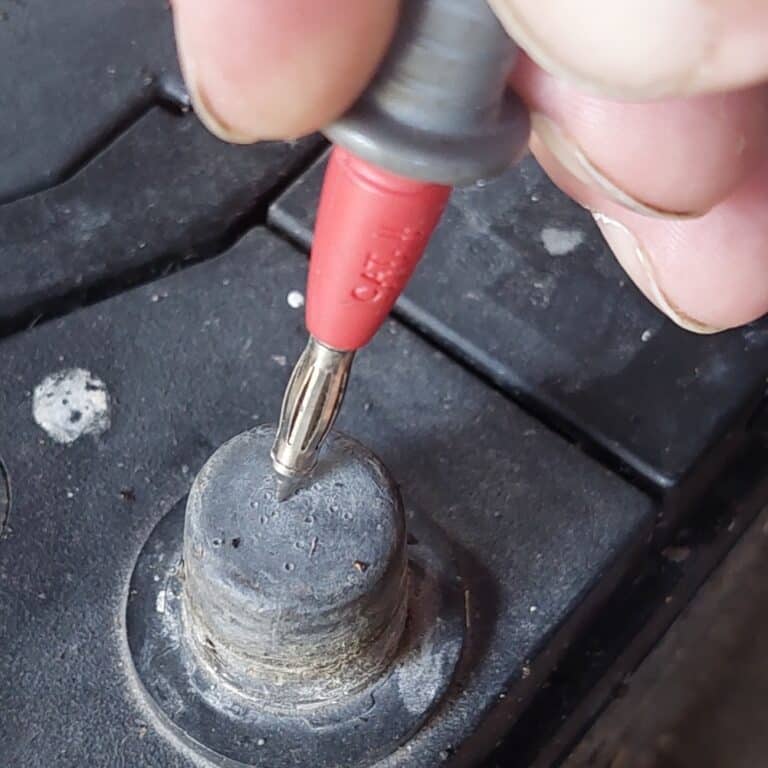
- Battery Health: With the engine off, a healthy 12V battery should read around 12.6V to 12.8V. With the engine running, you should see 13.2V to 14.4V, indicating the alternator is charging.
- Finding a Voltage Drop: If a light is dim, test the voltage between the light’s positive terminal and a good negative ground. If you have 12V at the battery but only 10V at the light, you have excessive resistance (corrosion or a bad connection) in the wiring.
2. Measuring Continuity: Tracing Wires and Finding Breaks
This test checks if a path for electricity is complete (like a single, unbroken wire). Important: Only do this test on circuits that are completely DE-ENERGIZED (power off) to avoid damaging your meter.

Set Up: Turn the dial to the continuity symbol; often marked with a sound wave symbol ))) or a speaker symbol or combined 🕪.
On some meters the continuity mode is a second-function of the resistance (Ω Ohms) range and is activated via the [Shift] button.
- The Test: Touch the two probes together. You should hear a beep, this proves that the meter is working and set up correctly. Now, place the probes at either end of a wire or fuse. If you hear a beep, the path is good. If not, the wire is broken or the fuse is blown.
This test is what you will use for checking if a switch is working or tracing where a wire goes in a bundle.
3. Measuring Resistance: Spotting Corrosion and Bad Grounds
Resistance is measured in Ohms (Ω). A good connection should have very low resistance.
- The Test: Again, the circuit must be off. Connect one probe to the battery’s negative terminal and the other to the engine block or a ground bus. You should see a reading very close to 0Ω. A high reading, more than 1Ω, suggests a poor or corroded ground connection that needs cleaning.
Tip:
Before you do this test touch the probes together and note the reading. Your test leads may or may not be calibrated to your instrument and therefore any reading other than zero must be subtracted from your measured value.
A Simple Fault-Finding Flow

Let’s say your navigation light isn’t working.
1. Check the Bulb/LED: Visually inspect it.
2. Check the Fuse: Use the continuity test to see if the fuse is intact.
3. Check for Voltage at the Socket: Turn the light on. Use your multimeter (set to DC Volts) at the socket’s contacts. If you have voltage, the socket, or bulb is likely the issue.
4. Check the Switch and Wiring: If there’s no voltage at the socket, work backward. Check for voltage on both sides of the switch. If there’s voltage in but not out, the switch is faulty. If there’s voltage at the switch but not at the light, there’s a break in the wire between them.
A multimeter empowers you to perform logical, step-by-step checks, saving time and often preventing unnecessary replacements. It turns a mysterious electrical failure into a solvable puzzle.
As with all things marine, if a fault seems complex or beyond your comfort zone, it’s always wise to consult an experienced marine electronics engineer. But for the common gremlins, a multimeter is the tool to have on board.
To learn more about marine electronics in general browse the articles on this site. If you want to know more about networking marine electronics take a look at the series
Warning
I’ll finish with a word of caution. Never ever connect a multimeter setup to measure current across a battery, or any other part of a circuit that could short battery voltage to ground, as the entire available current in the battery will try to flow through the meter; at best this will blow the internal fuse, AT BEST!


